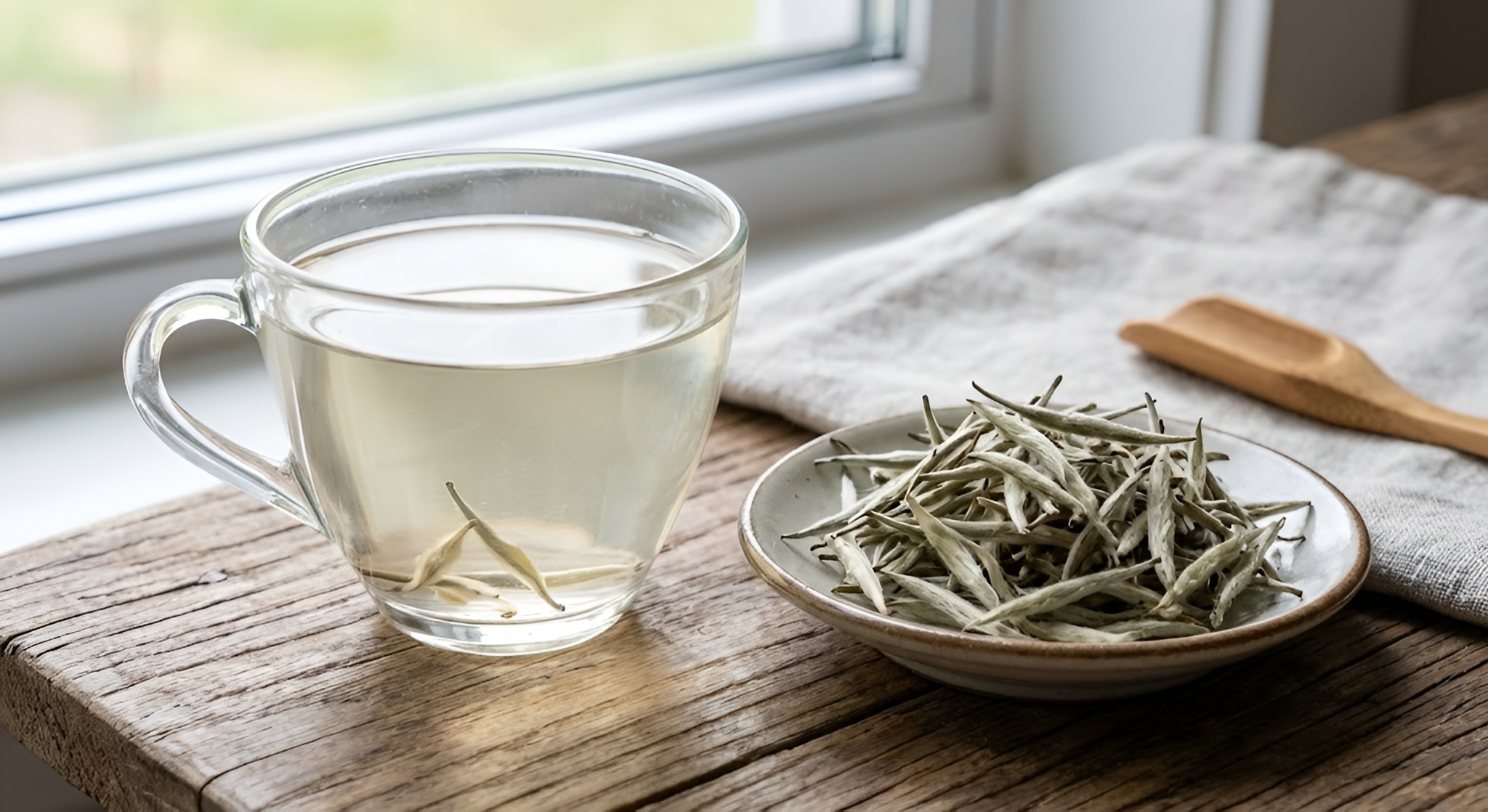
1. What Counts As White Tea
The technical definition: White tea is Camellia sinensis leaf that is withered and dried — nothing else. There is no fixing in a pan, no rolling, no controlled oxidation chamber. The leaf goes from fresh-picked to finished tea through two operations only: a long, slow wither under shade or weak sun (typically 36–72 hours) and a final low-temperature dry. The minimal processing is why the category exists at all: every flavour, aroma and chemical signature comes from the leaf itself plus what happens during the wither, not from anything the maker adds in a wok or a rolling machine. For the chemistry of what actually happens during that long wither, see our Fujian sun-wither enzyme guide.
The four traditional grades: Bai Hao Yin Zhen (Silver Needle — unopened buds only), Bai Mu Dan (White Peony — one bud, one or two leaves), Shou Mei (Longevity Eyebrow — larger, later-pluck leaves) and Gong Mei (Tribute Eyebrow — coarser, between Bai Mu Dan and Shou Mei). Yin Zhen is the prestige grade and the only one made exclusively from spring buds. We cover the bud-only style in depth in our Silver Needle guide and the leaf-and-bud blend in our Bai Mu Dan piece.
2. Where It Actually Comes From
Fujian is the origin and still the benchmark: Specifically the counties of Fuding and Zhenghe in northern Fujian, where the local cultivar (Da Bai, the ‘large white’ bush) produces the silvery, downy buds that gave the category its name. Fuding-style is softer and sweeter; Zhenghe is bolder, woodier and oxidises slightly further during the wither because of the cooler, wetter climate. Any white tea sold without a province on the label is almost certainly Fujian.
The non-Fujian whites: Yunnan now produces a meaningful volume of white tea from the large-leaf assamica cultivars normally used for pu-erh — the result is darker, fruitier and ages remarkably well. Nepal, Darjeeling and Sri Lanka all produce small-batch white teas using their local Chinese-hybrid bushes; these are pricey, hand-made and aimed squarely at the specialty market. A quick note on Anji Bai Cha: despite the name (‘white’) it is processed as a green tea and only the leaf colour is white — we explain that confusion in our Anji Bai Cha piece.
3. The Chemistry: Why It Tastes The Way It Does
Caffeine: White tea is the second-highest caffeine category by dry weight after matcha. A standard 200ml cup brewed at 80°C delivers roughly 30–55mg, with bud-heavy Yin Zhen sitting at the top of the range. The popular belief that white tea is ‘caffeine-free’ is wrong — it persists because the gentle flavour disguises the underlying dose.
L-theanine: White tea contains some of the highest L-theanine concentrations in the Camellia sinensis family, especially in the spring buds. L-theanine is the amino acid responsible for the ‘calm focus’ effect — it smooths the caffeine peak and extends the half-life. Combined with the relatively high caffeine, this is why an afternoon cup of Silver Needle delivers a measurable cognitive lift without the jitter of equivalent coffee. The mechanism is laid out in our L-theanine guide.
Polyphenols and catechins: Because oxidation is minimal, white tea preserves more of the original leaf catechins (especially EGCG) than oolong or black tea. This is the basis of the marketing claims about ‘the highest antioxidant content’ — technically true on a per-gram-dry-leaf basis, although per-cup figures depend heavily on brewing temperature and time. For the broader picture see our polyphenols glossary and the bioavailability question in polyphenol bioavailability.
4. How To Brew It Properly
Temperature: 75–85°C, never boiling. Boiling water bruises the delicate downy buds and pulls out astringent catechins that drown out the floral, melon-like character of a good Yin Zhen. If you are brewing in a glass gaiwan you should be able to see the bubbles forming at the bottom of the kettle but not reaching a rolling boil.
Leaf-to-water ratio: 4–5g per 200ml for Western brewing, 6–7g per 100ml for gongfu. Bai Mu Dan and Shou Mei tolerate longer steeps (3–5 minutes Western, 30 seconds gongfu) before they go bitter. Silver Needle should be kept on the shorter side (2–3 minutes Western) because the bud-only construction means caffeine extracts fast.
Vessels: Glass or unglazed porcelain. Avoid yixing clay — the clay absorbs the subtle aromatics and a well-seasoned pot will dominate the tea. The classic visual presentation is a tall glass with whole Yin Zhen buds standing upright as they hydrate. For the broader water question (mineral content matters enormously) see our brewing water guide and our companion piece on water–tea hydrogen bonding.
5. The Ageing Question
White tea is the only non-pu-erh category that genuinely ages: Properly stored Fuding white tea develops over 5, 10 and 20-year horizons into something closer to medicinal-grade material in southern Chinese tradition. Year 1: floral, hay, melon. Year 3: dried apricot, honey, light wood. Year 7: dates, leather, soft tannin. Year 15+: medicinal, almost herbal-spirit, with the colour of aged amber. Cake-pressed Shou Mei (the standard ageing format) is what most collectors buy because the compressed format slows oxidation evenly through the cake.
Storage: Dry, dark, odour-free, away from temperature swings. The biggest mistake British buyers make is leaving aged white tea in a kitchen cupboard near the kettle — the steam cycles destroy the cake within a year. A dedicated tea cabinet or a sealed pumidor (humidity-controlled cabinet) is the proper move for anything over £100.
6. White Tea And Health: What The Evidence Actually Says
Skin and collagen: The catechin profile in white tea has been studied for its inhibition of matrix metalloproteinases — the enzymes that break down collagen. The effect is real but small, and entirely topical in most published work. The fashionable ‘glass skin’ trend gets the direction right but overstates the dose-response — we put the actual numbers in our glass-skin piece.
Cardiovascular: The same catechin profile produces measurable improvements in flow-mediated dilation (a proxy for endothelial function) at 3–5 cups per day across short trial periods. The effect size is comparable to green tea and smaller than blood-pressure medication.
Cancer prevention: Mechanistic in vitro work is strong; human epidemiological evidence is mixed and confounded by the ‘people who drink premium tea also have better diets’ problem. Treat white tea as a pleasant addition to a generally healthy lifestyle, not a chemoprotective agent.
Arsenic: A persistent low-level concern with bud-only Yin Zhen because the tender shoots concentrate trace heavy metals from soil. The risk is real but tiny at normal drinking volumes; our silver needles and arsenic piece walks through the numbers honestly.
7. Buying White Tea In The UK
What to look for on the label: Province (Fuding or Zhenghe for prestige), cultivar (Da Bai), pluck date (spring is the best), pluck grade (bud-only, bud-and-leaf, leaf-grade) and whether the tea has been aged. Avoid generic ‘China White Tea’ with no provenance — it is almost always lower-grade Shou Mei sold as if it were Bai Mu Dan.
What to pay: Decent Bai Mu Dan starts around £15 per 50g. Spring Yin Zhen from Fuding starts around £30 per 50g. Aged cakes go up sharply — a 5-year Fuding Shou Mei cake is £60–100, a 15-year is £300+. Anything labelled ‘Silver Needle’ under £10 for 50g is misgraded Bai Mu Dan at best, broken Shou Mei at worst.
Where to buy: UK specialists with verified Fuding contacts: Postcard Teas, What-Cha, Canton, Curious Tea. Supermarket white tea (Twinings, Pukka, M&S) is almost universally Shou Mei or blended dust — perfectly drinkable but nothing like a proper bud tea.
Comments