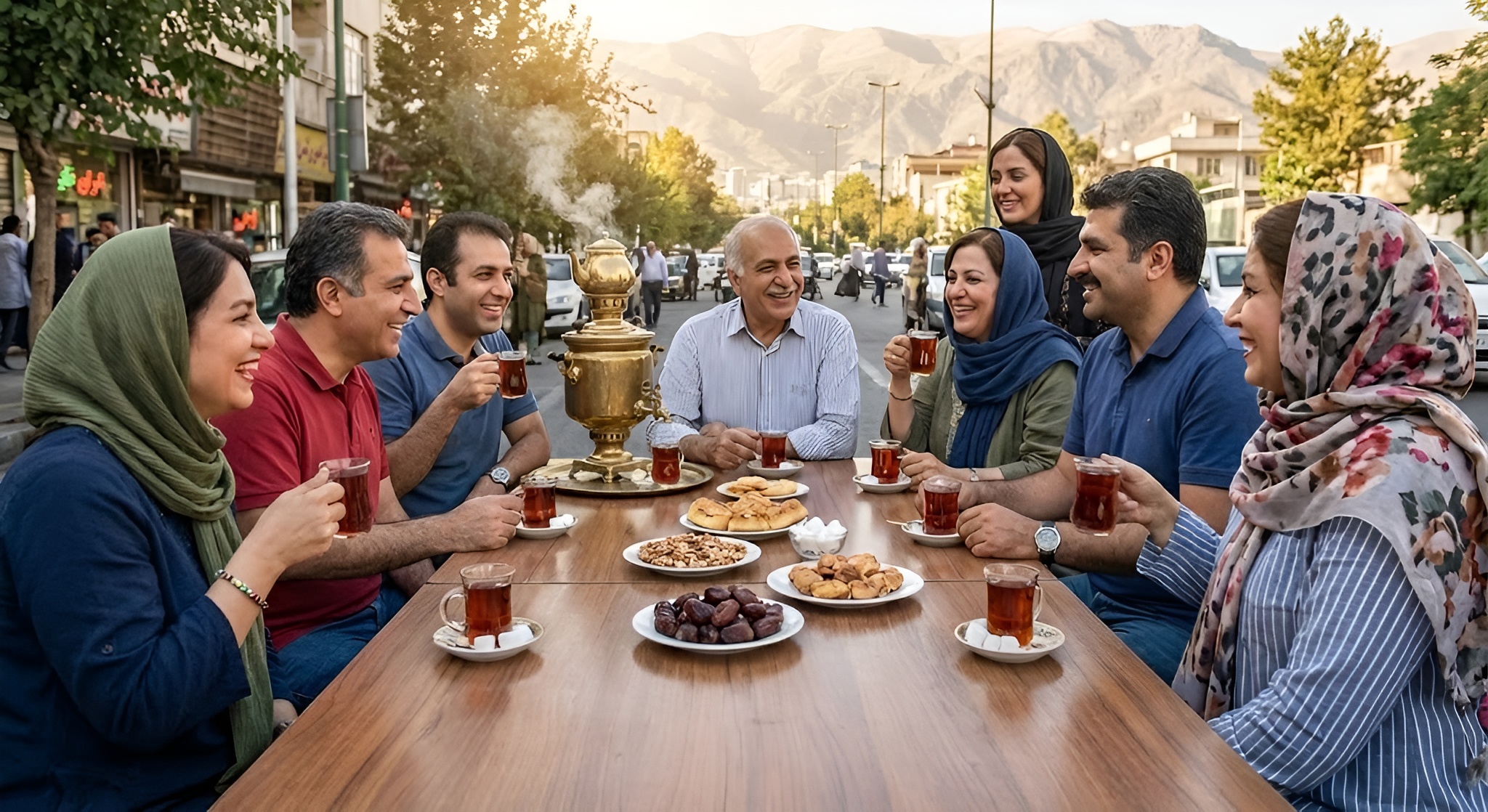
1. How Tea Reached Iran
The Silk Road handoff: Tea reached Persia overland from China along the Silk Road from roughly the 9th century onwards, but for the first eight hundred years of its presence it was an elite, religious-court curiosity rather than a popular drink. Coffee dominated Persian social life from the 16th century onwards — the qahveh khaneh (coffeehouse) was the standard urban gathering place in Safavid Isfahan. Tea remained a beverage of the Qajar court, drunk in small porcelain bowls imported from China and treated as a status object.
The 19th-century pivot: Two things changed in the 1890s. First, British control of the trans-Persian coffee routes pushed Yemeni coffee prices up sharply, making coffee unaffordable for most Iranians. Second, Prince Mohammad Mirza Kashef al-Saltaneh — the Iranian consul general in India — smuggled tea seedlings and processing knowledge out of British-controlled Bengal in 1898, disguised as a French labourer. The seedlings were planted in the Caspian-coast province of Gilan, where the humid subtropical climate proved nearly perfect for tea cultivation. Within twenty years tea had displaced coffee as the Iranian national drink. The full history is laid out in our Persian tea and Silk Road history piece.
2. The Lahijan Tea Region
Where Iranian tea actually grows: Almost all Iranian tea comes from Gilan and Mazandaran provinces along the Caspian Sea, with the town of Lahijan as the historical capital of the industry. The terrain is hill-country tea garden running from sea level up to about 800m, with high rainfall, mild winters, and acidic soil — conditions similar to Assam or low-elevation Sri Lanka. The Kashef al-Saltaneh National Tea Museum is in Lahijan, built around his tomb.
What it tastes like: Iranian black tea is malty, brisk and broken-leaf style, designed for the long high-temperature steeping that the Persian samovar method demands. It is not a delicate single-estate tea — it is a robust everyday workhorse tea, closer in style to a strong Ceylon BOP than to anything Chinese. About 80–90% of Iranian tea consumption is now imported (mostly from India, Sri Lanka and Kenya) because domestic production cannot keep up with demand, but the Lahijan-grown leaf still commands a premium and is preferred for ceremonial occasions.
3. The Samovar: The Engine Of Persian Tea
The vessel: A samovar is a metal urn with a central heating tube — traditionally charcoal-fired, now usually electric. The bulk vessel holds boiling water; a small teapot (the qori) sits on top of the urn, kept warm by the rising heat. The qori contains a strong concentrated tea brew (the dam) made with about twice the leaf-to-water ratio of British practice. To serve, you pour a measure of the strong dam into a glass and then top it up with fresh boiling water from the samovar tap, adjusting the strength to taste.
Why it works: The samovar method solves a problem that drip-brewing cannot: how to serve fresh, hot, strength-adjustable tea to a household or guest group across an entire afternoon without ever making a bad cup. The dam in the qori gets stronger over hours but does not get cold or stewed because it is constantly being diluted with fresh boiling water. A well-run samovar in a Tehran household will be on from breakfast until late evening and produce dozens of cups across the day. The closest Western equivalent is restaurant coffee from a thermos — same principle, much worse execution.
The qori (small teapot): Usually porcelain, sometimes silver-plated for ceremonial use. The shape matters: a good Persian qori has a wide base and a narrow neck so the leaves can swell without escaping into the dam. Modern Iranian households often use a generic glass teapot; traditional ones use hand-painted porcelain from Isfahan or Mashhad.
4. The Sugar Cube Ritual
How Iranians actually drink it: Tea is served in small glass cups called estekan — usually 80–120ml, narrow-waisted, set in a metal or porcelain saucer. Sugar is never stirred into the cup. Instead, you take a hard sugar cube (qand) in your front teeth, then sip the hot tea through the cube, letting it slowly dissolve as you drink. The cube lasts roughly half a cup; you take a fresh one for the second half. The practice has a name — chai ba qand, ‘tea with sugar’ — and a strict etiquette that we cover in detail in the Persian sugar-cube ritual piece.
Why this method matters: The sugar cube delivers sweetness to the front of the palate in a slow trickle, which preserves the tea’s underlying tannic structure. Stirred-in sugar flattens the tea and dulls the bitter-sweet balance that Iranians prize. The method also lets one person calibrate the sweetness per cup — a guest who wants strong tea but light sugar simply takes a smaller cube.
Nabat (rock sugar): A specifically Persian alternative is nabat, crystallised sugar formed around a thin wooden stick (often saffron-yellow). The stick is stirred into the tea where it dissolves slowly. Nabat is mildly medicinal in Persian tradition (recommended for sore throats and digestive upsets) and is almost always served with tea in pharmacies and traditional cafes.
5. What Iranians Eat With Tea
The standard accompaniments: Tea is almost never served alone in a Persian household. The standard service includes dates (especially Bam dates from Kerman province), dried mulberries (toot khoshk), pistachios, and a small bowl of noql (sugared almonds). For more formal occasions add saffron rice pudding (sholeh zard), rosewater cakes (nan-e nokhodchi), and the saffron-and-pistachio nougat called gaz.
The herbal additions: Persian tea is sometimes served plain and sometimes scented at brewing with a small amount of cardamom, rose petal, or saffron — never all three together. A bowl of fresh mint leaves on the table lets the drinker add a few leaves to the estekan for hot summer afternoons.
The Ramadan particular: During Ramadan the post-iftar (post-sunset meal) tea service becomes the central social event of the day. Tea is served strong and sweet, dates are essential, and the gathering can stretch for hours. The same post-iftar tea ritual runs across most of the Middle East and connects directly to the older Sufi traditions of tea-as-meditation we cover in our Sufi tea traditions piece.
6. Tea And Persian Hospitality (Ta’arof)
The cultural function: Offering tea is the fundamental Iranian gesture of hospitality. A guest who enters any Iranian home, office or shop will be offered tea within minutes — refusing the first offer is polite (the cultural ritual of ta’arof, performative humility) but the host will offer again, and accepting the second offer is expected. To refuse twice is to indicate that you are not actually welcome, which is socially serious. A Westerner doing business in Iran needs to learn this rhythm or constantly insult their hosts by accidentally cutting off the social contract.
The serving order: Eldest first, then guests, then male family members, then female family members, then children. The hostess (typically) does not drink until everyone else has been served. The serving etiquette is identical at a corporate meeting and at a family dinner — it is a fixed social grammar rather than a domestic convention.
What it shares with other tea cultures: The Persian tea-as-hospitality framework is structurally identical to Moroccan mint tea service, Turkish çay culture in Rize, and Japanese senchadô — all four cultures treat the offering of tea as a binding social contract rather than a neutral beverage choice. The differences are in the vessels and brewing method, not the social function. See our Turkish tea culture piece and senchadô piece for the comparison.
7. Buying Persian Tea And Setting Up A Samovar In The UK
Where to find proper Lahijan tea: Persian and Iranian grocers in London (especially around Edgware Road and in Wembley), Manchester, Birmingham and Glasgow stock genuine Lahijan-region tea, usually in 250g and 500g foil packs branded Refah, Golestan or Sahar. Expect to pay £6–10 for 500g — an order of magnitude cheaper than equivalent-quality Indian or Chinese tea because the supply chain is short.
Samovars: Electric Iranian samovars (Pars Khazar is the dominant brand) are widely available online for £60–120. Traditional charcoal samovars are collector items; for the brewing method an electric model works identically. A set of six estekan glasses with saucers will cost another £15–25 from the same online vendors.
The qori: Any small porcelain teapot of 250–400ml will work for the dam. Persian grocers sell purpose-made qori with hand-painted Esfahani decoration; a generic ceramic teapot will produce identical tea but is less photogenic on the samovar.
Cardamom and rosewater for blending: Iranian green cardamom pods and Persian rosewater (try Sadaf brand) are available at any Middle Eastern grocer. Crush one pod and add to the dam at the brewing stage; add a single drop of rosewater per cup at serving time. Do not combine the two — one or the other.
Comments