1. The Earl Himself: Charles Grey, 2nd Earl Grey (1764–1845)
The man, not the tea: Charles Grey was a Whig prime minister from 1830 to 1834 — the last aristocratic Whig PM and the one who pushed through the 1832 Great Reform Act and the 1833 Slavery Abolition Act. By the time the blend bearing his name was on a single shop shelf he had already secured his political legacy and retired to his Northumberland estate at Howick Hall. The tea was almost an afterthought to a serious historical career, which is one reason the origin story is so loosely documented — Grey himself never wrote about it.
The Howick Hall version: The official family story, repeated by the current Earl Grey and on the Howick Hall website, is that a Chinese mandarin gave Grey the blended tea as a diplomatic gift in the 1830s, after one of Grey’s envoys saved the mandarin’s son from drowning. The blend supposedly used bergamot oil to mask the high mineral content of the Howick Hall water (the estate’s spring is famously hard). Lady Grey then served it to guests, the recipe spread through Whig society, and a London tea merchant eventually asked permission to sell it commercially. None of this can be independently verified in any contemporary source, but the family has stuck to the story for nearly two centuries.
2. The Problems With The Origin Story
The dates do not work: Charles Grey never visited China and there is no record of any of his envoys saving a mandarin’s son. China was effectively closed to British diplomatic contact during Grey’s lifetime — the First Opium War broke out in 1839 and the formal treaty system began with the Treaty of Nanking in 1842, three years before Grey’s death. The ‘mandarin’s gift’ chronology is therefore very tight at best and almost certainly retroactive.
The bergamot doesn’t work either: Bergamot is a citrus grown commercially almost exclusively in Calabria in southern Italy. Adding bergamot to Chinese black tea would have been a genuinely unusual cross-cultural blend in the 1830s — not something a Chinese mandarin would plausibly have devised. The much more likely route is that a London or Bristol tea merchant created the blend domestically to disguise inferior or stale tea, and then attached an aristocratic name for marketing purposes after Grey was safely dead.
The first hard evidence: The earliest verifiable advertisement for ‘Earl Grey’s Mixture’ appears in 1884 in a Charlton & Co. advertisement — thirty-nine years after Grey died. Twinings and Jacksons of Piccadilly both claim to have been the original blender, with the dispute still unresolved.
3. What Bergamot Actually Is
The fruit: Citrus bergamia, a hybrid of bitter orange and lemon, grown almost exclusively in a 100km strip of Calabrian coastline because the fruit demands a very specific microclimate. The peel is cold-pressed to extract the essential oil — about 100 fruits yield 90g of oil, which makes proper bergamot expensive enough that almost all supermarket Earl Grey uses synthetic linalyl acetate (the dominant aroma compound) instead of the real oil.
Why it works on tea: Bergamot oil is unusually rich in linalyl acetate and linalool, which sit on top of the bright, brisk character of a Chinese keemun or Ceylon base without burying the underlying tea. Mediocre tea bases get flattered; great tea bases get distorted — which is why connoisseurs argue that proper Earl Grey should use a competent but not premium black tea. There is also a meaningful drug-interaction story with bergamot (it inhibits CYP3A4 in some statin patients) — we cover that in the Earl Grey drug-interaction piece.
4. The Splinter Blends: Lady Grey, French Earl Grey, Earl Grey Cream
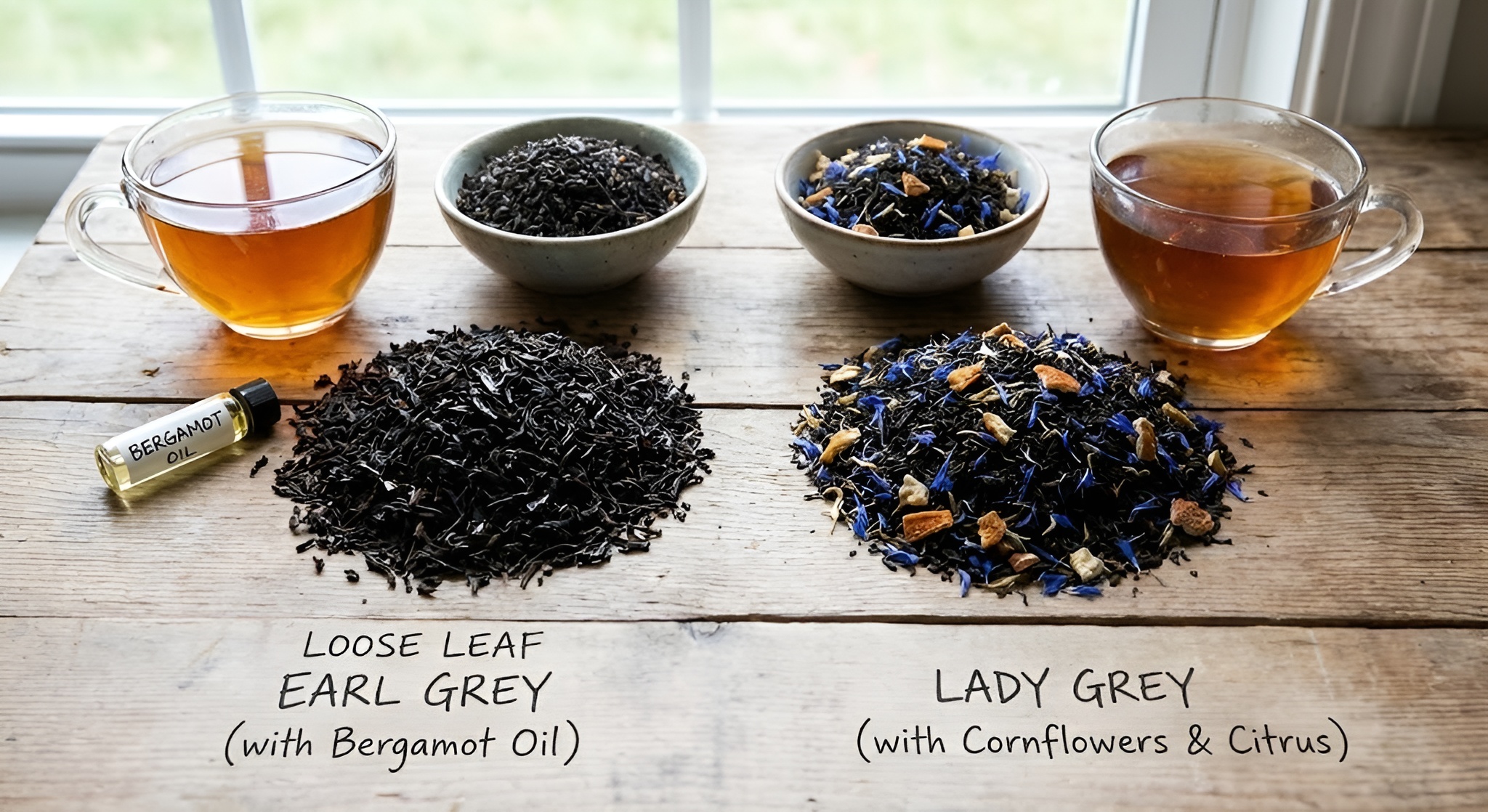
Lady Grey (trademarked by Twinings in 1994): A lighter, more citrus-forward version with added lemon and orange peel, named for Mary Elizabeth Grey, the Earl’s wife. Pure 20th-century invention — she had nothing to do with it — but commercially significant: Lady Grey was Twinings’ first new product in 50 years and remains one of their top sellers. We cover the side-by-side in our Earl Grey vs. Lady Grey piece.
French Earl Grey: A modern (1990s) variant adding rose petals, cornflowers and sometimes mango or strawberry to the standard bergamot base. Marketed heavily by T2 and Fortnum & Mason. Drinkable but not historically Earl Grey in any meaningful sense.
Earl Grey Cream (or Earl Grey Crème): Adds vanilla bean or vanilla extract to the standard blend. The combination of bergamot, vanilla and black tea is genuinely good and works beautifully in baking — see our Earl Grey and chocolate pairing piece for why.
Russian Earl Grey: Black tea, bergamot, and Russian Caravan’s signature smoky lapsang souchong. A specialty-shop blend that almost no supermarket carries.
5. The 20th-Century Rise And The Brand Wars
Twinings vs. Jacksons: Both London houses claim to have been the original commercial blender, with Twinings owning the modern trademark for ‘Earl Grey’ in most jurisdictions despite Jacksons publishing the earlier verifiable advert. The two firms quietly settled in the 20th century by both selling Earl Grey and not pressing the historical claim too hard in court.
The Patrick Stewart effect: Earl Grey’s late-20th-century surge in international popularity is genuinely attributable to Star Trek: The Next Generation. Captain Jean-Luc Picard’s ‘Tea. Earl Grey. Hot.’ ran from 1987 to 1994 and made the blend the default order for American viewers who had never previously thought about tea preferences. Twinings’ US sales tripled across that period.
The supermarket flooding: By the 2000s every UK supermarket house brand sold an Earl Grey, almost all using synthetic bergamot flavouring rather than cold-pressed Calabrian oil. The price point collapsed from a luxury blend to a 60p box, and the quality with it. Specialty buyers responded by moving to single-estate Earl Grey from blenders like Bird & Blend, Whittard’s premium line, and Postcard Teas.
6. Brewing Earl Grey Properly
Water temperature: 95°C, just off boiling. The black tea base needs the heat to extract properly, and the bergamot oil is heat-stable enough to survive it. Boiling water actually helps liberate the volatile aromatics from the oil.
Steep time: 3–4 minutes for a strong cup, no more. Earl Grey is one of the few black teas where over-steeping produces a chemical, perfumed bitterness rather than just standard astringency — the bergamot compounds change character at long steeps in a way that the underlying tea doesn’t.
Milk: A genuinely contentious question. Traditional British practice is a splash of milk; the bergamot purists insist that milk fats bind to the bergamot aromatics and dull the citrus. Both positions are defensible — if you grew up on supermarket Earl Grey with milk, you may genuinely prefer it that way. With proper cold-pressed Calabrian bergamot, milk-free is the standard recommendation. For the broader question of milk-in-tea see our milk-first science piece.
Loose leaf vs. bags: The bergamot oil volatilises rapidly once the leaf is crushed and exposed to air. Tea bags are typically months old by the time they reach your kitchen, and the bergamot aroma is significantly degraded. Loose leaf bought in 50–100g batches within the last six months is dramatically better.
7. Buying Earl Grey In The UK Today
Supermarket tier: Twinings classic and Twinings strong are still the volume-leader benchmarks — perfectly drinkable everyday tea, synthetic bergamot, reliable. Tesco, Sainsbury’s and Waitrose house brands are tier-below and obviously so.
Premium tier: Whittard Earl Grey No.1, Fortnum & Mason Earl Grey Classic, Twinings Earl Grey No.1 (their premium line, not the standard) all use real bergamot oil and step up noticeably. Around £8–12 per 100g.
Specialty tier: Bird & Blend, Postcard Teas, Canton, Curious Tea and What-Cha all carry single-origin Earl Grey blends with named base teas (keemun, Ceylon Uva, Nilgiri) and cold-pressed Calabrian bergamot. £15–25 per 100g and worth it if you drink Earl Grey daily. We cover the specific buying choices in our companion best Earl Grey review.
Comments